TestAS Preparation Guide from A–Z: Study Roadmap, Time Management, and Scoring High on Your First Try
TestAS is not a memory test. The examination does not require memorizing complex formulas or lengthy academic definitions. Instead, it measures analytical velocity, quantitative data interpretation, and problem-solving ability in a foreign language under strict time constraints.
Walking into the exam relying purely on "natural talent" without a deliberate strategy frequently leads to being overwhelmed by dense data sets. This guide synthesizes battle-tested experience to help you establish a structured preparation plan, master exam pacing, and maximize your score on the very first try.
1. What is TestAS and Why Are Scores Crucial?
TestAS (Test für Ausländische Studierende / Test for Academic Studies) is a standardized aptitude test evaluating readiness for undergraduate study at German universities and German-partner institutions.
Admissions committees evaluate 4 core dimensions via TestAS:
- Logical reasoning and abstract deduction.
- Interpretation of charts, matrices, and scientific tables.
- Information processing speed under acute time limits.
- Aptitude alignment with the chosen academic discipline.
Top German universities and prestigious domestic institutions such as Vietnamese-German University (VGU) prioritize TestAS for three compelling reasons:
- Credibility: Standardized metrics provide impartial evaluation, bypassing discrepancies between differing high school grading standards.
- Fairness: All international candidates complete identical benchmark assessments.
- GPA Compensation: A top-tier TestAS score balances an average high school transcript and significantly strengthens scholarship eligibility.
Read the foundational overview: What is TestAS? Exam Structure, Fees, and Registration Guide 2026.
2. TestAS Structure: Understanding the Blueprint
TestAS comprises two distinct sections:
Section 1: The Core Test
A mandatory section for all candidates regardless of field. It evaluates foundational cognitive ability across 4 primary question formats:
- Pattern Recognition: Identifying 2D and 3D visual transformations.
- Quantitative Problems: Applying core arithmetic to solve rapid numerical word problems and series.
- Inferring Relationships: Determining semantic logic between word pairs and abstract concepts.
- Completing Patterns / Numerical Reasoning: Analyzing matrix arrays and data tables to deduce missing elements.
Section 2: Subject-Specific Modules
Candidates choose 1 field matching their intended major (expanded to 6 fields under Digital TestAS):
- Engineering: Diagram interpretation, mechanical physics, and spatial projection.
- Economics: Financial charts, supply-demand mechanics, and process flowcharts.
- Mathematics, Computer Science and Natural Sciences: Algorithmic logic, experimental data, and scientific graphs.
- Humanities, Cultural and Social Sciences: Text comprehension, argument extraction, and contextual analysis.
3. How Difficult is TestAS?
Short answer: The underlying concepts are straightforward, but the time pressure is intense.
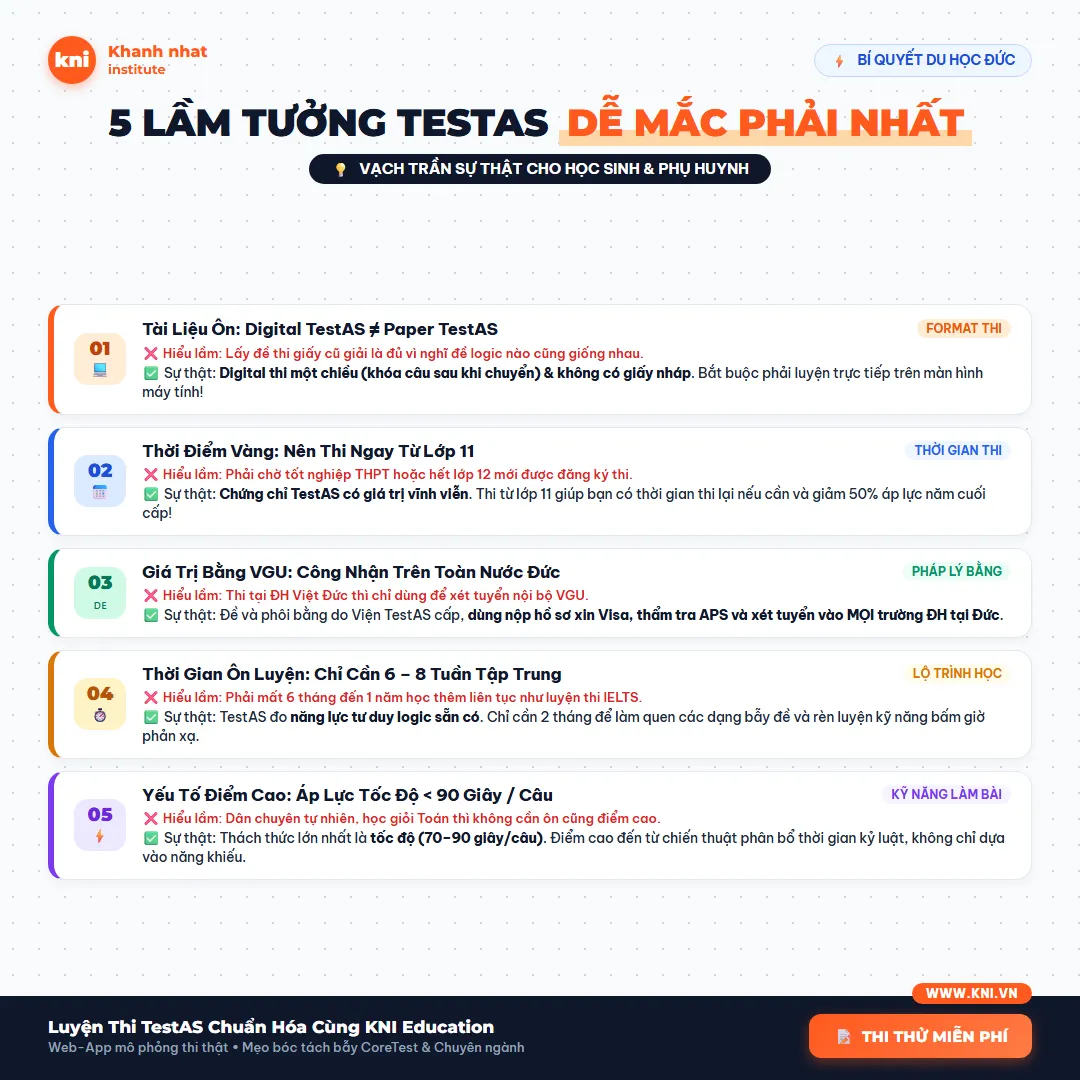
Assuming no studying is needed because it lacks memorization is the single most common mistake. TestAS difficulty stems from 3 challenges:
- Extremely Tight Pacing: You have only 70 to 90 seconds per question on average. Within that time, you must comprehend academic English/German, parse data, and deduce answers.
- Dense Distractor Data: Questions frequently embed superfluous figures intended to sidetrack candidates.
- Cognitive Fatigue: High question density over several hours demands sustained concentration.
Therefore, tactical pacing and pattern reflex matter far more than encyclopedic knowledge.
4. 3-Phase Study Roadmap in 4 to 8 Weeks
A structured 1-to-2-month plan trains your problem-solving reflexes systematically:
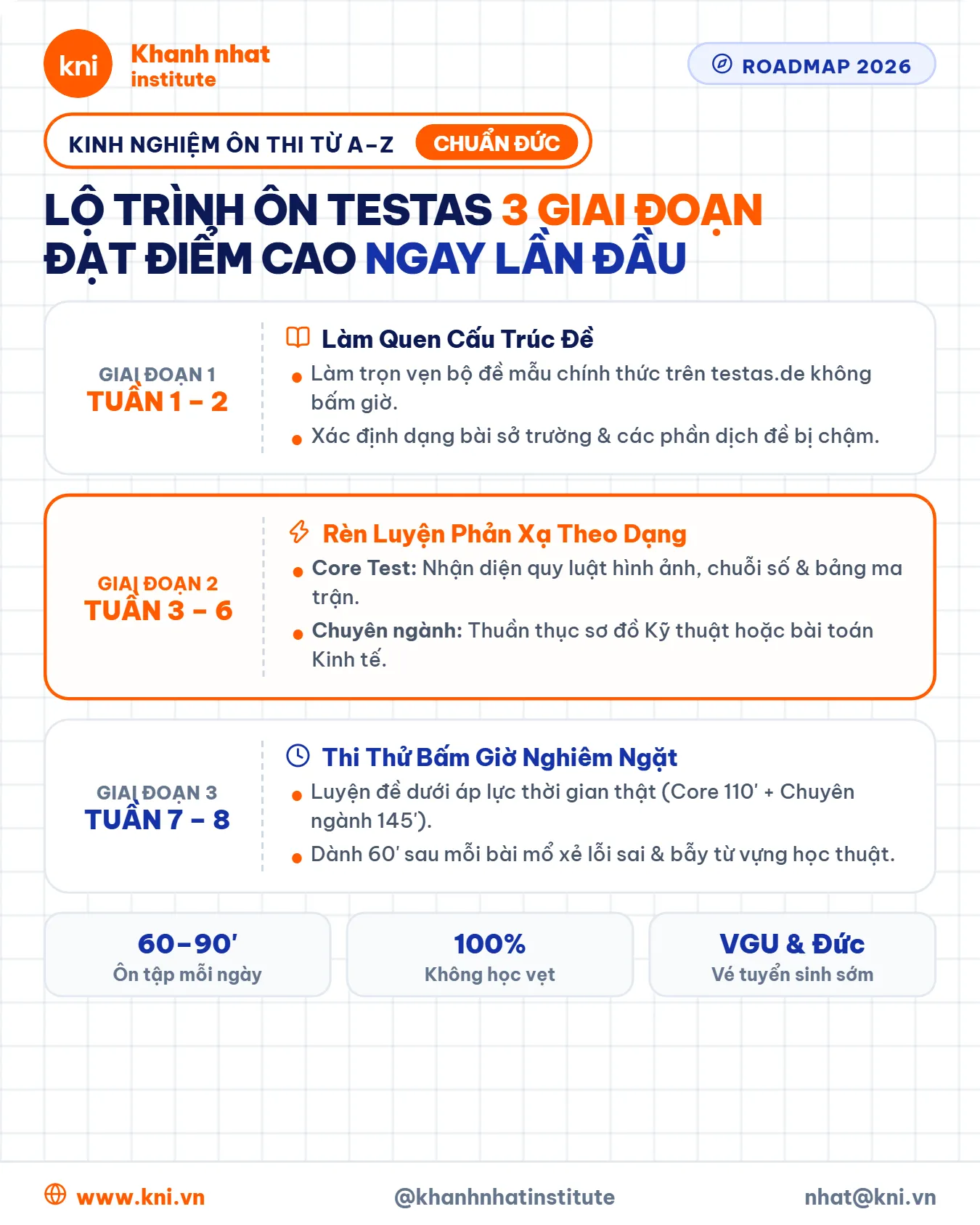
Phase 1: Familiarization & Diagnostic (Weeks 1–2)
Understand every section and establish your baseline without time constraints.
- Download official sample questions from testas.de.
- Complete an untimed diagnostic test.
- Log which sections you solved effortlessly and where you got stuck on terminology or calculation.
Phase 2: Targeted Subtest Conditioning (Weeks 3–6)
Address identified weak areas directly:
- Core Test: Solve daily Latin square and number pattern drills. Avoid guessing; identify the exact rule governing the sequence.
- Engineering: Train spatial visualization by mentally rotating 2D cross-sections into 3D objects.
- Economics: Practice rapid analysis of axes, scales, and break-even thresholds in business graphs.
Phase 3: Full-Length Timed Simulations (Final 2 Weeks)
Simulating actual testing conditions is essential:
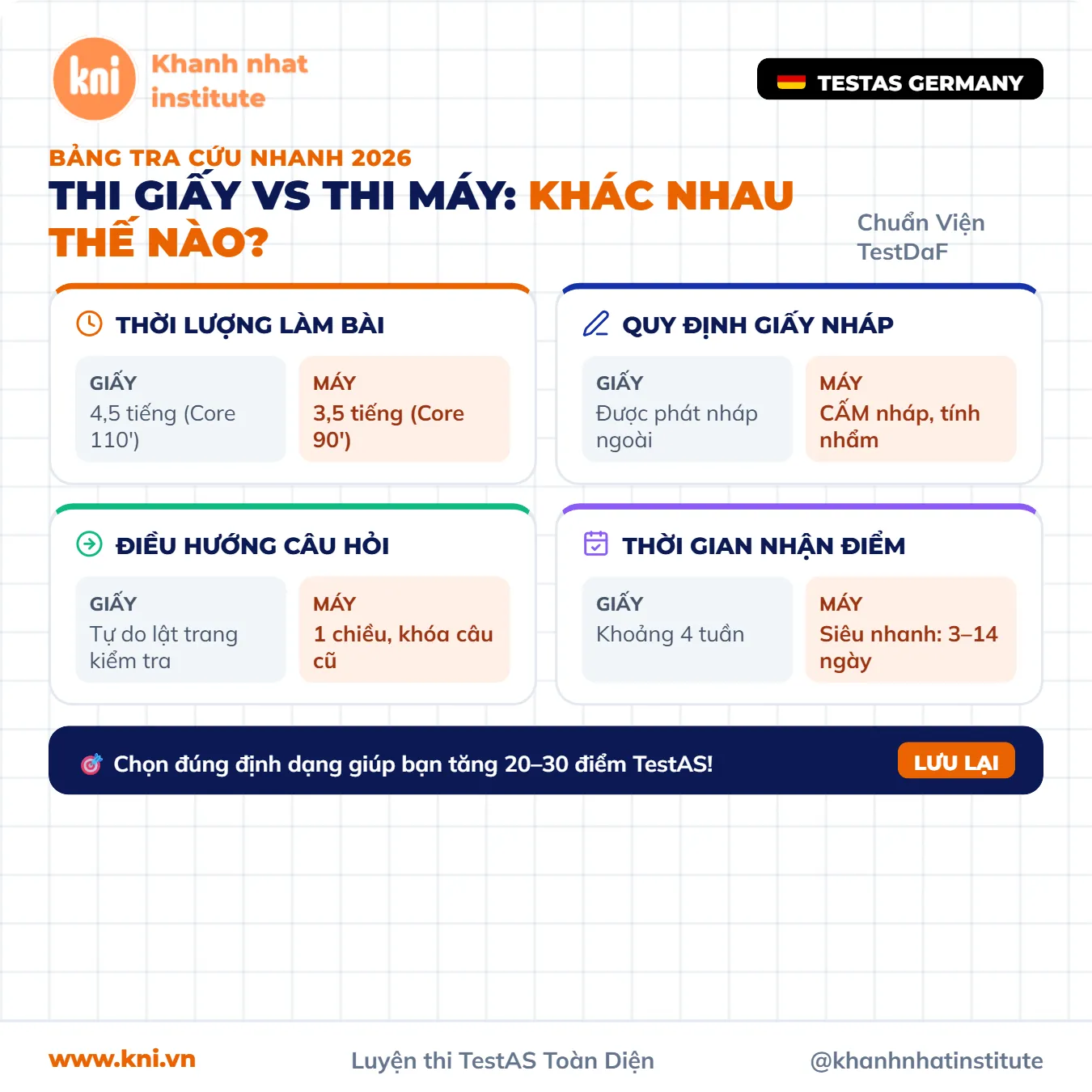
- Strictly enforce official section timers.
- Work in quiet environments without translation dictionaries.
- Spend at least 60 minutes after every mock test auditing mistakes: Was the error caused by vocabulary, careless arithmetic, or reading the wrong chart axis?
5. Exam Room Tactical Execution
Apply these battle-tested principles on test day:
| Principle | Action | Benefit |
|---|---|---|
| 2-Minute Rule | Move on if no solution path appears within 60 seconds. Mark for review if testing on paper. | Prevents one stubborn problem from burning 5+ crucial minutes. |
| Easy Items First | Rapidly scan and bank points on obvious visual or arithmetic items first. | Builds momentum and eases cognitive anxiety. |
| Scrutinize Negatives | Underline qualifying words (NOT, EXCEPT) and numerical units (thousands, millions, percentages). | Eliminates careless reading traps. |
| Zero Blank Answers | Always submit your best guess before section expiry (no negative marking). | Captures free statistical points. |
Physical and Mental Preparation
- Secure 8 hours of sleep before exam day. Late-night cramming reduces brain processing speed by up to 20%.
- Arrive 20–30 minutes early with valid identification (original ID card or passport).
- Maintain steady breathing: Remember every candidate is racing the exact same clock.
6. Common Mistakes That Drain Points
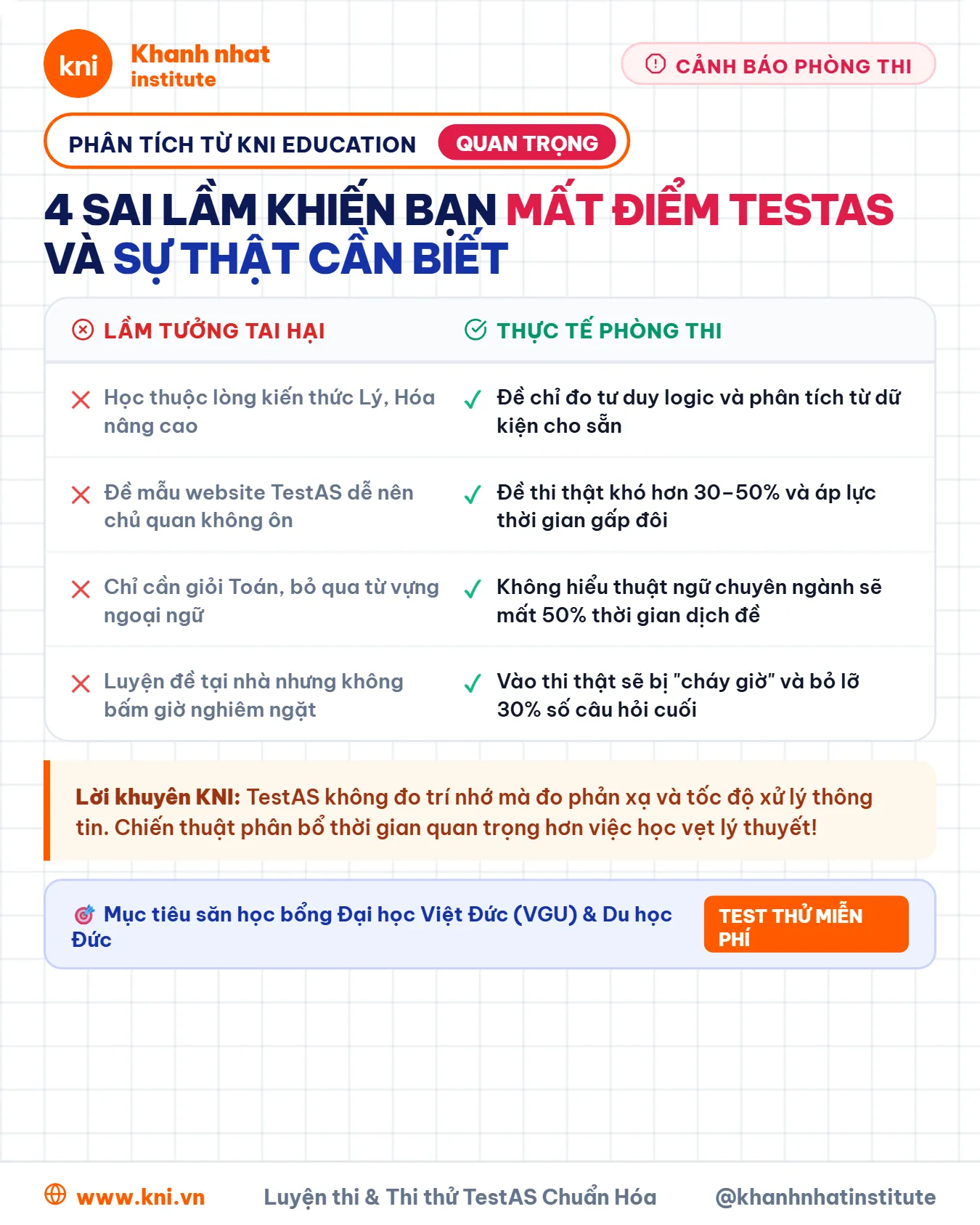
- Studying Advanced University Theory: TestAS tests analytical intuition from given premises, not university-level calculus or organic chemistry.
- Neglecting Academic Vocabulary: Terms like proportional, inversely related, and extrapolate must be recognized instantly.
- Skipping Timed Drills: Arriving at the exam room without speed conditioning leaves 30% of questions untouched.
- Getting Bogged Down: Fixating on one outlier problem sacrifices 3–4 easier subsequent questions.
7. How Long Do You Need to Prepare?
For most students, 4 to 8 weeks is optimal:
- 60 to 90 minutes daily: Consistent daily exposure establishes sharper neural reflexes than marathon weekend sessions.
- Candidates with advanced math and English backgrounds: Can compress prep into 3 to 4 weeks dedicated to speed drills and full mocks.
8. When Should You Take TestAS?
Invest in TestAS if you:
- Are applying to German universities requiring TestAS in admission criteria.
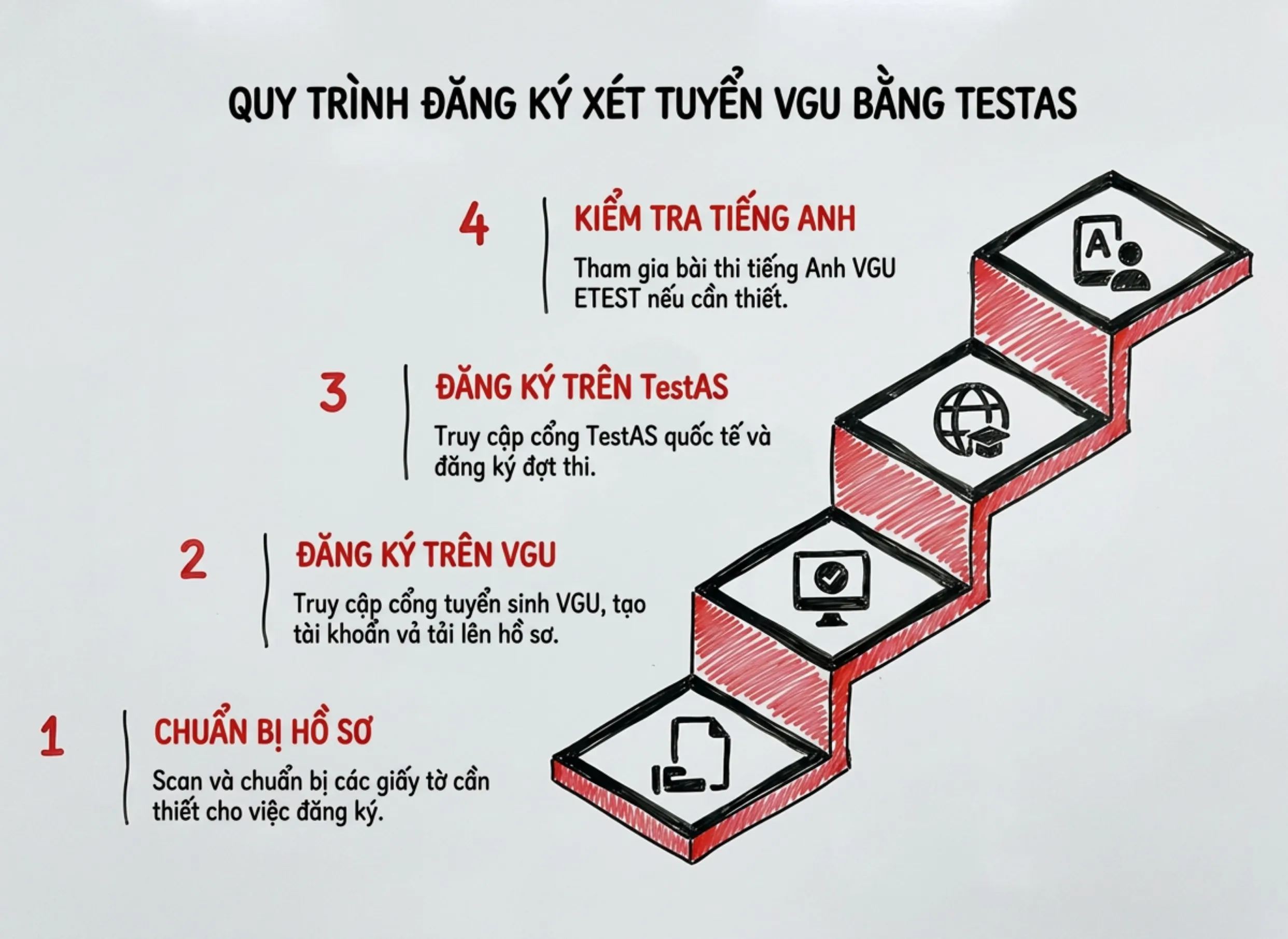
- Seek early admission and merit scholarships at Vietnamese-German University (VGU) via dedicated entrance pathways.
- Want an international standardized credential to reinforce average high school transcripts.
Conclusion
TestAS is not an insurmountable barrier. It is an objective measure of structured logic and mental agility. With clear structural familiarity, disciplined pacing, and focused practice drills, you can confidently secure competitive scores on your first attempt.

Effective TestAS Coaching at KNI Education
Whether you need a baseline diagnostic, authentic timed mock tests, or a personalized roadmap aligned with university admission thresholds, KNI Education provides expert guidance every step of the way.
👉 Book a personalized consultation or take our free diagnostic TestAS exam today.